

As more and more research clearly shows the health benefits of whole grains, countries and organizations around the globe are increasingly including whole grains in their dietary recommendations. Here are some of those we’re aware of. If you know of any others, email us and we’ll add them to the list!
Australia – The Australian Guide to Healthy Eating
“Enjoy grain(cereal) foods, mostly wholegrain and/or high cereal fibre varieties.” The daily grain recommendation for adults aged 19 to 50 years is 6 servings for both women and men, 4 for older adults and small children, and 7 servings for older adolescents. A serving equates to one slice of bread; ½ cup of cooked rice, pasta or noodles; ½ cup of porridge; ⅔ cup cereal flakes; or ¼ a cup of muesli.” (2013) Click here for full text.
Canada – Canada’s Food Guide
“Make at least half of your grain products whole grain each day. Eat a variety of whole grains such as barley, brown rice, oats, quinoa and wild rice. Enjoy whole grain breads, oatmeal or whole wheat pasta.” At least three servings of whole grains are recommended for all Canadians age 9 and up. (2007) Click here for full text.
Denmark – Report of the National Food Institute
In May 2008, the DTU (National Food Institute) issued a detailed report on the health benefits of whole grains that recommended, overall, that Danes consume a minimum of 75g of whole grains daily (Based on a 2400 calorie diet; proportionately less for children and for smaller women. For a 2000 calorie diet this would be about 63 g daily.). Click here to download the English summary of the report’s recommendations. (60K PDF)
France – La Santé Vient en Mangeant (Health comes from Eating)
Eat bread and starchy foods at every meal… Whole grains are … rich in fiber. Bread [should be] preferably whole grain or semi-whole grain. (2011) Click here for more.
Germany – 10 Guidelines of the German Nutrition Society (DGE)
“Plenty of cereal products — and potatoes. Bread, pasta, rice, grain flakes preferably made of whole grain, and potatoes contain nearly no fat, but plenty of vitamins, minerals, trace elements as well as dietary fibre and phytochemicals. Combine these products with low-fat food items.” Click here for full text.
Mexico – Norm for Nutrition Guidance
The Mexican Health Ministry, in 2004, released its NOM-043 guidelines stating that, “Consumption of cereals should be recommended, preferably whole grains or their derivates and starchy roots. Their fiber and energy content should be highlighted”.
Download the 2006 update of this document, in Spanish. (516K PDF)
Oman – Eat Your Way to a Healthier Day
Oman’s Department of Nutrition, Ministry of Health, released guidelines in May 2009 that recommend “It is advised to consume at least a third of daily consumption of cereals from whole grain bread and foods that contain whole grains such as Harees, barley soup, etc. Therefore for an average diet of 2000 calories 2-3 servings of whole grains daily is advised. “
Download the 2009 Oman guidelines, in English (3.6M PDF)
Netherlands – Netherlands Nutrition Centre
The Netherlands Nutrition Centre recommends everyone age 9 and up eat 4-7 slices of whole grain bread (4-5 for those 9-13 or 70+; 5-6 slices for age 51-70; and 6-7 slices for 14-50 year olds), resulting in a typical intake of 115g of whole grain per day.
Singapore Dietary Guidelines
Singapore’s Health Promotion Board advises adults that “Out of the 5-7 servings of Rice & Alternatives, 2-3 servings should be whole-grain food. All you have to do is replace your refined items with whole-grain items. E.g. instead of white rice, go for brown rice.”
Spain
The Spanish Society of Community Nutrition (SENC) updated its “Dietary Guide for the Spanish People” in 2015. It says, “Grains and the products derived from them, along with other foods rich in complex carbohydrates, are the basis of proper nutrition.” The recommendation focuses on prioritizing whole grains and products made from whole grain flours.” The grains portion of their dietary pyramid clearly shows whole (integral) grains as the preference.
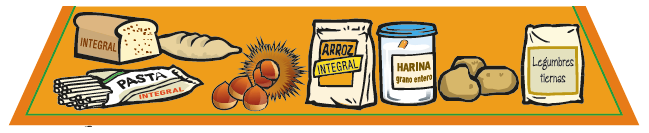
Sweden – Report of Livsmedelsverket (National Food Administration)
In January 2010, Sweden’s Livsmedelsverket updated its nutrition advice to focus not just on whole grain bread, but on all varieties of whole grains. Overall, it recommends that Swedes, like the Danes, consume 75g of whole grain per 2400 calories, a level they generalize to be about 70g for most women and about 90g for most men. The report is available in Swedish on their website (using Google translator, the meaning comes through clearly).
Switzerland – Swiss Society for Nutrition Food Pyramid
According to the Swiss Society for Nutrition, “Each meal should be served with 1 starch-rich side dish (i.e. 3 portions a day) including at least two portions of whole grain products.” Download the English PDF (2009)
United Kingdom – the Eatwell Plate
The UK’s Food Standards Agency uses the Eatwell Plate as its food guidance image, and advises that, “Starchy foods such as bread, cereals, rice, pasta and potatoes are a really important part of a healthy diet. Try to choose wholegrain varieties whenever you can. … We should all be trying to eat a variety of starchy foods and choosing wholegrain, brown or high-fibre varieties whenever we can.” Click here for full text.
United States – Dietary Guidelines for Americans
“Shifting from refined to whole-grain versions of commonly consumed foods—such as from white to 100% whole-wheat breads, white to whole-grain pasta, and white to brown rice—would increase whole-grain intakes and lower refined grain intakes to help meet recommendations.” This means that at least three servings of whole grains are recommended for all Americans age 9 and up. (2005, 2010, 2015) Click here for full text.
Other EU Guidelines on Whole Grains
In 2002, the WHO Regional Office for Europe, Nutrition and Food Security program prepared a report comparing Dietary Guidelines in 49 countries in Europe and western Asia. This report noted the following specific recommendations for whole grains:
Hungary: 5-9 unit/day of cereals (mostly whole grains)
Norway: More whole grain products
Greece: 8 servings/d of non-refined cereals and products: whole grain bread, whole grain pasta, brown rice etc, not including potatoes on daily basis.
Slovak Republic: Increase intake of cereals and cereal products (mainly whole grain products)
Croatia: Bread, grains and preferably whole grain products, rice and potatoes.
WHO / FAO
In 2003, the World Health Organization and the Food and Agricultural Organization of the United Nations released a report titled “Diet, Nutrition and the Prevention of Chronic Diseases.” The summary of this report recommended that governments institute policies “supporting the availability and selection of nutrient-dense foods (fruits, vegetables, legumes, whole grains, lean meats and low-fat dairy products).
Health Groups Recommend Whole Grains
(US) American Heart Association
Dietary Recommendations for Children and Adolescents: “Serve whole grain breads and cereals rather than refined grain products. Look for ‘whole grain’ as the first ingredient on the food label and make at least half your grain servings whole-grain. Recommended grain intake ranges from 2 oz. per day for a one-year-old to 7 oz. per day for a 14-18 year old boy.”
Five Healthy Eating Goals: “Eat more whole-grain foods. Like fruits and vegetables, whole-grain foods are low in fat and cholesterol and high in fiber. Whole-grain foods include whole-wheat bread, rye bread, brown rice and whole-grain cereal.”
(US) American Diabetes Association
Making Healthy Food Choices: “Choose whole grain foods over processed grain products. Try brown rice with your stir fry or whole wheat spaghetti with your favorite pasta sauce.”
Evidence-Based Nutrition Principles and Recommendations for the Treatment and Prevention of Diabetes and Related Complications (2002): “Foods containing carbohydrate from whole grains, fruits, vegetables, and low-fat milk should be included in a healthy diet.”
(US) American Cancer Society
Recommendations for Nutrition and Physical Activity for Cancer Prevention: “Choose whole grains in preference to processed (refined) grains and sugars. Choose whole grain rice, bread, pasta, and cereals. Limit consumption of refined carbohydrates, including pastries, sweetened cereals, soft drinks, and sugars.”
(US) American Gastroenterological Association Institute
Recommendations: “Because the purported protective effect of dietary fiber against CRC [colorectal cancer] is demonstrated better by fiber-rich foods (e.g., vegetables, fruits, grains, cereals) than by dietary fiber alone, it is also reasonable to recommend consumption of 5-7 servings of vegetables and fruits per day and generous portions of whole-grain cereals.”
(EU) European guidelines on cardiovascular disease prevention in clinical practice
Recommendations: “The consumption of the following foods should be encouraged: fruits and vegetables, whole grain cereals and bread, low fat dairy products, fish, and lean meat.”