

Share This

When you cut into a loaf of whole grain bread, do you ever think about how you’re participating in a tradition thousands of years old? Archaeological examples of bread making date back 14,000 years, but actual pieces of preserved bread found in archeological digs are few and far between, which makes some recent finds particularly exciting. Bread has held special historical importance to Mediterranean cultures, with new discoveries in Switzerland and Turkey highlighting bread’s central role in ancient Roman and Anatolian cultures.
What started as land clearning for a residential development project in Switzerland turned into archaeologists uncovering a carbonized Roman bread loaf in the ruins of Vindonissa, an ancient Roman legionary camp in present-day Switzerland. Don’t let the term “camp” mislead you—this was a dense, sprawling urbanized military settlement with water pipes, sewers, theaters, and markets. The newly discovered loaf, announced in April 2026, dates back to the first century CE, and is believed to be the first Roman bread discovered in Switzerland. The oven it was found nearby was quite large, suggesting a level of commercial cooking for the settlement. The bread was burnt and preserved by fire, which prevented normal decomposition; the dig team was couldn’t recognize the charred slab at first, until it was sent to a lab for analysis!
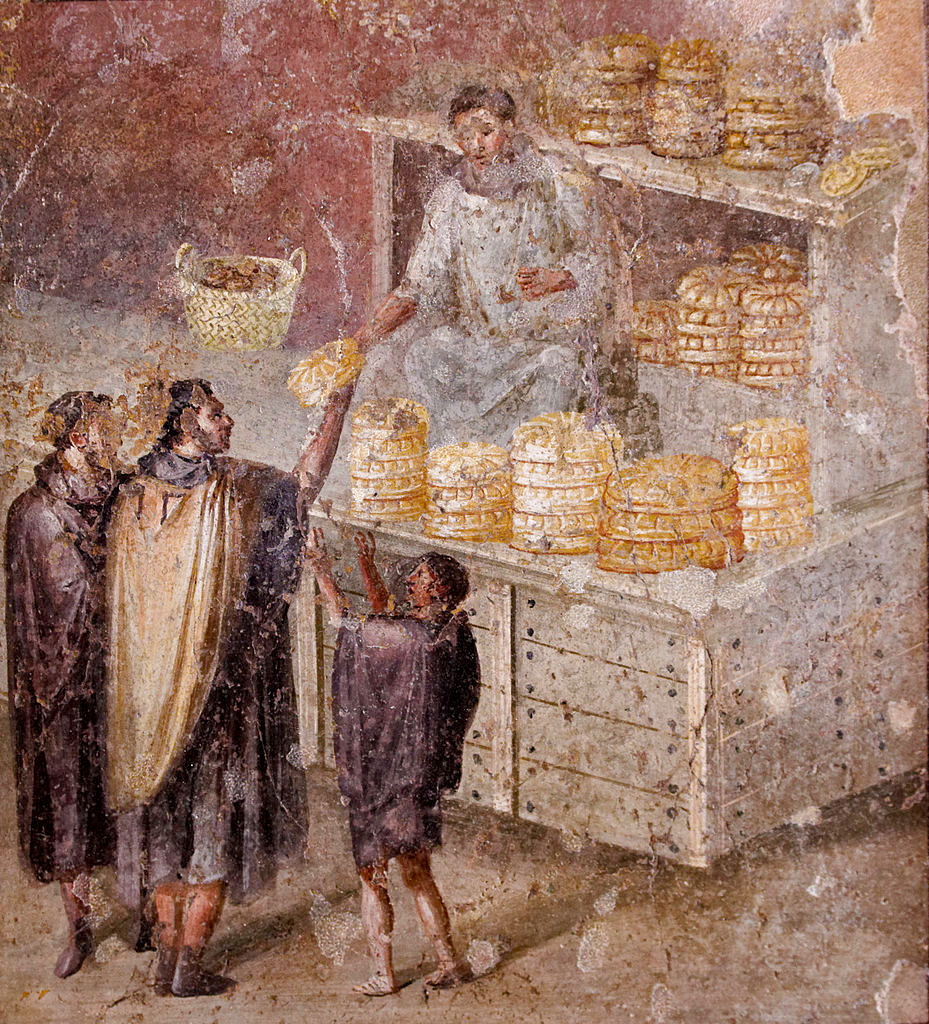
Pre-modern milling methods commonly retained all parts of the grain kernel, including bran and germ—the same as whole grain milling today. Ancient bakers were highly skilled, and historical sources describe techniques for dough preparation and fermentation alongside industrial baking methods, including mills and kneading machines powered by horses. In the ruins of Pompeii and Herculaneum, there are the remains of many bakeries that used to sell their products in these ancient cities. In Pompeii alone, they’ve excavated over 35 bakeries, and it’s possible more remain in the unearthed ruins. The British Museum even has a recipe for Ancient Roman whole grain bread panis quadris, based on the preserved loaves from Herculaneum. Another common bread was the ring-shaped arculata, for which there are also modern recipes. Grain was so important to the Roman economy that historians have used records of wheat and barley trade to estimate the empire’s population. It makes sense that bread was a fundamental fuel for ancient cultures, and that ample time was spent perfecting baking methods; these breads contained more fiber, nutrients, and texture than highly refined modern breads (just like whole grain bread does today!). Ancient Romans likely ate a mix of whole grain breads, most commonly baked with wheat varieties like bread wheat, durum, and emmer, but also with millet and barley. Pliny the Elder wrote in his records that emmer made the sweetest bread!
Bread wasn’t important to only ancient Romans; whole grains’ role as a staple food was widespread throughout the Mediterranean region. In 2025, at the Bronze Age archaeological site Küllüoba in central Turkey, researchers uncovered another remarkably preserved loaf dating back roughly 5,000 years. This bread was found intentionally buried beneath a house in Turkey, possibly as part of a religious ritual, made from coarsely ground emmer wheat and lentils. Emmer is one of the oldest forms of wheat, and one of the earliest domesticated grains; in fact, some of the oldest examples of domesticated emmer comes from the Göbekli Tepe ruins in Turkey. The mayor of the nearby town called Eskisehir had the idea for a bakery in town to recreate the loaf in partnership with the researchers, using a mix of Kavilca wheat, bulgur wheat, and lentils to let the loaf rise again. The bread is now for sale daily at the bakery, and the inital batch sold out within hours. Residents have said they love the flavor and connection to local history, and it’s inspired civilians and politicians nearby the Küllüoba to shift their focus to growing their region’s heritage grains.
Another bread, this one 8,600 years old, was discovered in 2024 at the southern Turkish archaeological site Çatalhöyük, one of the earliest sites of urbanization. What makes this find unique is that the dough was uncooked, preserved as a “palm-sized, round, ‘spongy,” residue. It survived under a layer of thin clay covering the oven structure. Around the dough were wheat, barley, and pea seeds, all vitally important and common crops in ancient Anatolian cultures.
These old-world breads, made with whole grain flours like spelt, barley, and emmer are closer to modern whole grain loaves than white sandwich bread. These discoveries remind us that bread has always been more than simple sustenance. Ancient cultures cultivated a wide range of grains adapted to local environments long before modern agriculture homogenized the global food supply around a few highly standardized crops. Across ancient Mediterranean societies, these grains have been the base of daily life, trade, and community. Looking to the past can help inspire a more diverse and resilient future for all of us. (Vik)
To have our Oldways Whole Grains Council blog posts (and more whole grain bonus content!) delivered to your inbox, sign up for our monthly email newsletter, called Just Ask for Whole Grains.
Add a Comment